Best CRM for Marketing Agencies in 2026 (Comparison Guide)
By HL Max12 min read
Looking for the best CRM to streamline your marketing agency in 2026? Here's the deal: managing clients, campaigns, and leads can get messy without the right tools. A CRM tailored for agencies simplifies workflows, boosts efficiency, and helps you focus on growing revenue - not juggling software.
Here’s a quick rundown of the top contenders:
- GoHighLevel: All-in-one platform with white-label options, multi-client management, and real-time lead integration. Ideal for agencies wanting to consolidate tools.
- HubSpot Marketing Hub: User-friendly with modular features for marketing, sales, and service. Great for scalability but can get pricey as you add features.
- ActiveCampaign: Budget-friendly with strong email and marketing automation. Perfect for smaller agencies but lacks built-in multi-client tools.
- Salesforce Marketing Cloud & Pardot: Enterprise-level power with advanced automation and analytics. Best for large agencies but requires significant resources to manage.
Quick Comparison
| Platform | Best For | Starting Price | Key Features | Potential Drawbacks |
|---|---|---|---|---|
| GoHighLevel | Agencies consolidating tools | $97/month | CRM, funnels, messaging, white-label options | Requires ongoing automation oversight |
| HubSpot Marketing Hub | Scaling agencies | Free, paid plans vary | Multichannel automation, AI tools | Costs increase with advanced features |
| ActiveCampaign | Small agencies or startups | $15/month | Email automation, lead scoring | Limited multi-client management |
| Salesforce Marketing Cloud & Pardot | Large, enterprise-level agencies | $25/user/month | Advanced dashboards, robust security | High costs, steep learning curve |
If you’re prioritizing tool consolidation and client management, GoHighLevel might be your go-to. For enterprise-grade features, Salesforce may fit better. Each platform has strengths depending on your agency’s size and goals. Choose wisely to simplify operations and drive growth.
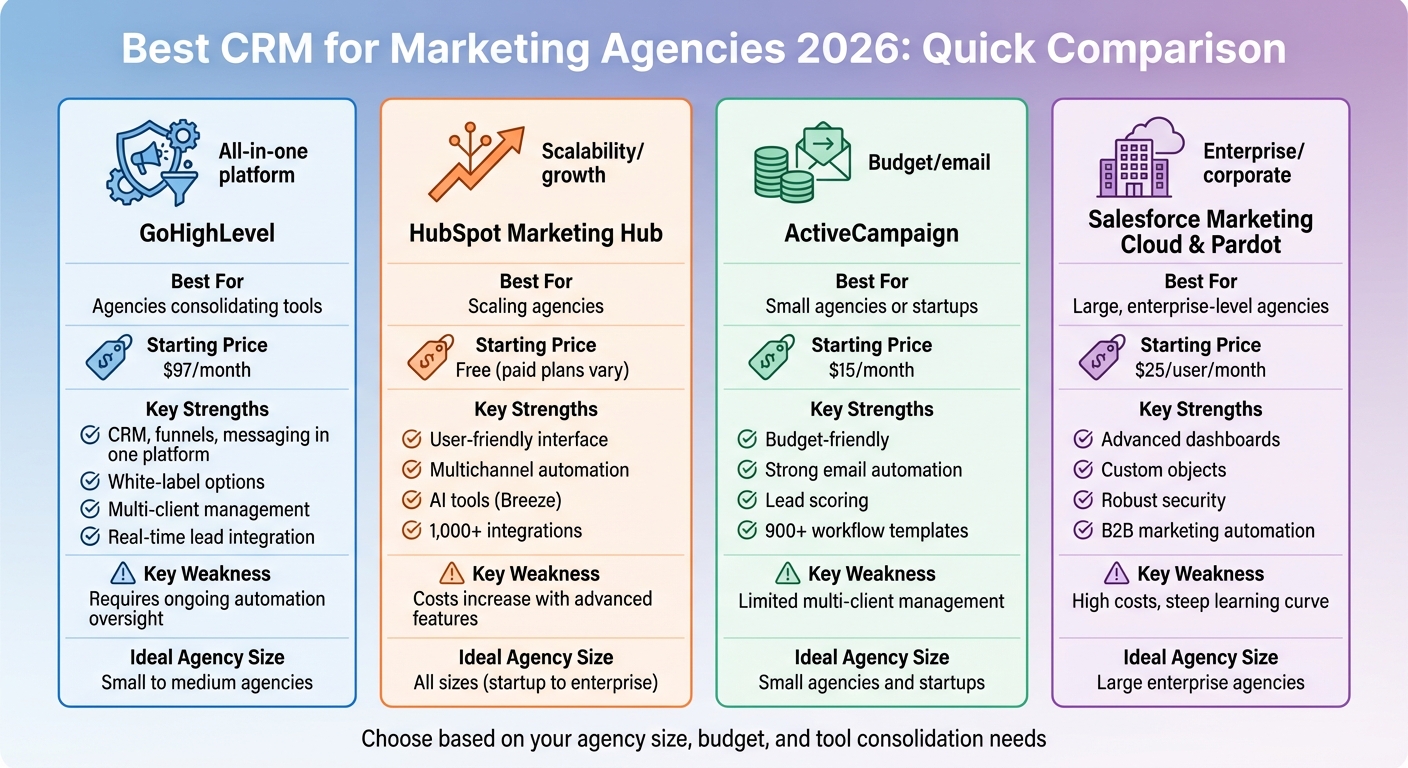
CRM Platform Comparison for Marketing Agencies 2026
+7 Best CRM for Agencies for 2025 (Ranked by Best Use Cases & Categories)
1. GoHighLevel
HighLevel is designed specifically for marketing agencies looking for an all-in-one platform. Instead of juggling multiple tools for CRM, landing pages, email campaigns, SMS, and reporting, HighLevel brings everything under one roof. This consolidation means fewer logins, lower subscription costs, and less time wasted switching between different applications.
Agency-Specific Features
One of HighLevel's standout features is its white-label option, which allows agencies to rebrand the platform and present it as their own. It’s a game-changer for agencies handling multiple clients, as it supports multi-pipeline and multi-brand setups. This means you can create separate pipelines, custom objects, and specific permissions tailored to each client.
Another major perk is its real-time lead capture. HighLevel syncs directly with platforms like Meta, LinkedIn, TikTok, and Google, ensuring leads are instantly captured. From there, agencies can automate follow-ups via SMS and email, move prospects through customized pipelines, and trigger instant lead notifications. The platform also supports inbound webhook triggers, making it easy to integrate external data into workflows. Together, these tools simplify client management and lay the groundwork for scalable pricing models.
Pricing and Scalability
HighLevel's pricing structure is built with growth in mind. Whether you’re a solo consultant or managing a large team, the platform allows you to oversee multiple client accounts from one centralized dashboard. To keep workflows running smoothly, agencies should regularly review and update automation settings.
Streamlining Tools
HighLevel also addresses the issue of tool overload. By combining funnel building, marketing, scheduling, and more into a single platform, it reduces operational complexity. For those who still need external tools, HighLevel offers APIs, webhooks, and custom integrations to ensure seamless connectivity. Plus, its reporting capabilities clearly link marketing efforts to revenue, making it easier to measure ROI.
Managing Multiple Clients
Managing multiple clients is simple with HighLevel’s setup. Agencies can create branded environments for each client, complete with custom pipelines and automated communications. AI-powered tools further streamline day-to-day workflows, helping agencies manage industry-specific routing and other repetitive tasks. This structure reduces administrative headaches, eliminates the need to constantly switch between client contexts, and ensures a polished, professional experience for everyone involved.
2. HubSpot Marketing Hub
HubSpot has earned its reputation as a reliable CRM for agencies, regardless of size. It offers a suite of specialized "hubs" for marketing, sales, service, content management, and operations. These hubs are designed to work seamlessly together, allowing you to start with the Marketing Hub and expand into other areas as your agency grows. However, it's worth noting that this modular pricing can become expensive as you add more hubs over time.
Agency-Specific Features
The HubSpot Marketing Hub delivers multichannel marketing automation through a user-friendly visual workflow builder. It supports email, SMS, social media, and ad campaigns - all in one place. HubSpot has also embraced AI with its Breeze software, which enhances analytics, content creation, and personalization. AI-powered tools like the Customer Agent (for support), Prospecting Agent (for lead research), and Content Agent (for scalable content creation) are particularly useful for agencies juggling campaigns across multiple platforms. That said, these tools don’t specifically focus on agency-client collaboration in the way HighLevel’s white-label features do.
Pricing and Scalability
HubSpot’s free CRM is a great starting point, supporting up to 1,000,000 contacts with basic automation. This makes it easy for agencies to test the waters without upfront costs. However, as agencies grow and incorporate multiple hubs, the pricing can escalate quickly. While HubSpot is equipped to handle agencies of all sizes - from small startups to enterprise-level operations - the cost structure can be challenging for smaller agencies still building their client base. This pricing model, while feature-rich, may leave smaller agencies wishing for a more streamlined and cost-effective solution.
Tool Consolidation
HubSpot aims to centralize marketing, sales, and customer service functions into a single platform, covering most aspects of the customer journey. It also integrates with over 1,000 third-party apps, offering flexibility for additional functionality. However, it falls short in areas like project management, time tracking, project profitability, and resource planning. For agencies that need to manage both client work and internal operations, this gap means relying on extra software, which adds to both costs and complexity. This limitation highlights where HubSpot’s "all-in-one" promise doesn’t fully meet the needs of agencies looking for a comprehensive operational solution.
3. ActiveCampaign
ActiveCampaign started as an email marketing tool but has since grown into a platform offering full sales and marketing automation combined with an integrated CRM. It’s a solid pick for agencies that rely on automation to manage campaigns across email, SMS, and social media. With more than 900 customizable workflow templates and a user-friendly drag-and-drop builder, it’s designed to help agencies scale their efforts efficiently. This shift has made ActiveCampaign a strong contender for agencies looking to manage cross-channel campaigns seamlessly. What sets it apart is its specialized workflow templates and smooth integration capabilities.
Agency-Specific Features
ActiveCampaign shines in marketing automation by offering features like dynamic personalization, AI-driven content creation, and detailed website tracking paired with lead scoring to measure performance. Its sales CRM add-on takes things a step further by integrating marketing automation into the sales pipeline. This is especially useful for B2B clients, as it helps identify leads, automate follow-ups, and even forecast revenue through win probability calculations.
Pricing and Scalability
Pricing starts at $15 per month, making it a budget-friendly option for smaller agencies or those just starting out. However, if you need access to the sales CRM features, you’ll need the Plus plan, which begins at $108 per month for 1,000 contacts and 1 user. ActiveCampaign also offers a 30-day free trial, giving agencies ample time to test its features before committing. While the entry-level pricing is appealing, keep in mind that costs can rise as your contact list and team size expand.
Tool Consolidation
With support for over 900 integrations, ActiveCampaign ensures flexibility when working with various client tools. However, it doesn’t include features like project management, time tracking, or resource planning, meaning you’ll need additional software to handle internal operations.
sbb-itb-f031672
4. Salesforce Marketing Cloud and Pardot
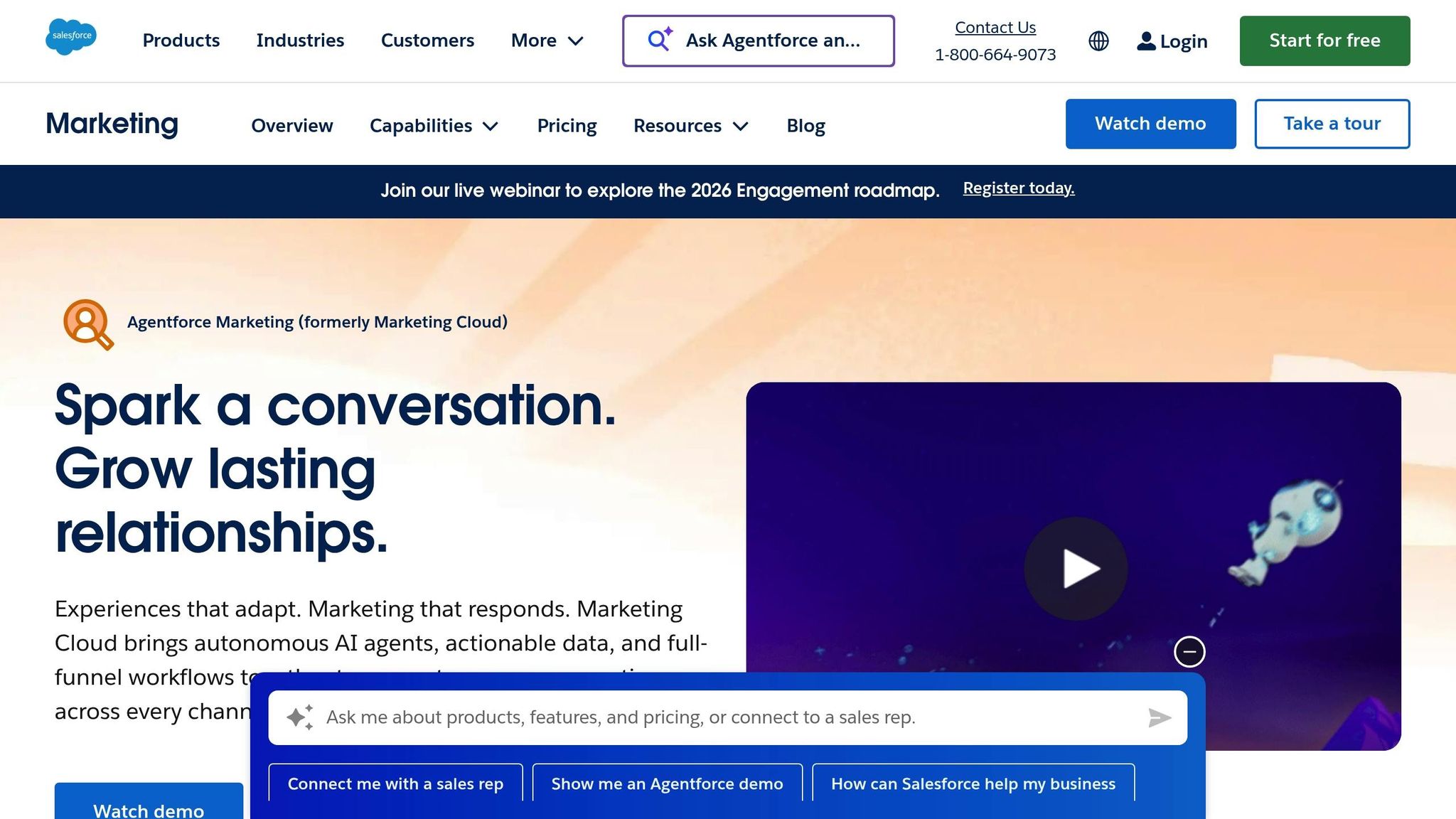
Salesforce Marketing Cloud and Pardot are powerful tools designed for managing complex marketing campaigns at an enterprise level. Marketing Cloud specializes in automating email, mobile, and advertising campaigns, offering advanced options for personalizing content. Pardot, on the other hand, focuses on B2B marketing automation, emphasizing lead generation and account-based targeting. Both platforms are part of the Salesforce ecosystem, ensuring seamless integration with other products like Sales Cloud and Service Cloud to support a wide range of agency operations. Together, they create a robust foundation for handling high-volume, multi-channel campaigns efficiently.
Agency-Specific Features
Salesforce provides tools tailored to agency needs, such as custom objects, enterprise permissions, and advanced dashboards, which enable precise client data management and detailed reporting. The platform captures leads in real time from major channels and updates audience lists for remarketing purposes. Conversion Sync, powered by conversion APIs, ensures accurate performance tracking by closing the attribution loop. Additionally, Salesforce Professional Services Cloud adds value with custom workflows for tracking clients and projects, paired with AI-driven forecasting tools for smarter planning.
Pricing and Scalability
Salesforce's pricing reflects its extensive capabilities. Sales Cloud costs range from $25 to $300 per user per month, while Professional Services Cloud starts at $75 per user per month, with advanced features priced at $90+ per user per month. Implementation services and additional users or features can increase the overall costs. While the platform scales effectively for large agencies, its complexity requires dedicated administration to fully utilize its potential.
Tool Consolidation
When used as part of the broader Salesforce stack, the platform acts as an all-in-one solution for core agency functions. However, features like project management, time tracking, and invoicing may require additional integrations. Salesforce's extensive marketplace of third-party apps and integrations allows for a highly customizable system. That said, the steep learning curve and the need for significant administrative resources make it most suitable for agencies with dedicated IT or operations teams to tailor the platform to their workflows. This kind of tool consolidation becomes especially important when managing multiple client accounts at scale.
Multi-Client Usability
Custom objects and enterprise permissions provide a clear separation of client data while allowing for adjustable access levels across team members. Marketing Cloud's automation capabilities and Pardot's cross-channel targeting simplify the management of multiple campaigns. At the same time, Salesforce ensures enterprise-grade data security, safeguarding sensitive client information. These features make it a reliable choice for agencies handling diverse client portfolios.
Comparison: Strengths and Weaknesses
Selecting the ideal CRM for your agency boils down to understanding how each platform performs in areas that matter most - like all-in-one functionality, pricing, workflow management, and multi-client support. Here's a breakdown of the strengths and weaknesses of key platforms:
| Platform | Key Strengths | Key Weaknesses |
|---|---|---|
| GoHighLevel | Combines CRM, funnels, and messaging into a single platform. Includes white-label options for agency branding and offers robust workflow controls, such as Inbound Webhook triggers for real-time data integration. | Requires consistent oversight to maintain automations - workflows can become inefficient without active management. |
| HubSpot Marketing Hub | User-friendly interface with native integrations. Offers a free tier for testing core features and provides extensive educational resources and community support. | Costs rise quickly as you add users or need advanced features. Full marketing automation and custom reporting are only available in higher-tier plans. |
| ActiveCampaign | Affordable starting price for smaller agencies, with strong email automation and segmentation. Delivers reliable email performance and includes integrated CRM features. | Primarily centered on email marketing - features like funnel builders, SMS, and client portals require third-party tools. Lacks built-in capabilities for managing multiple clients. |
| Salesforce Marketing Cloud and Pardot | Designed for enterprise-level scalability with advanced dashboards, custom objects, and robust B2B marketing automation. Offers top-notch security for handling client data. | Comes with a steep learning curve, high costs, and the need for dedicated IT resources. |
For agencies managing multiple clients and tools, GoHighLevel stands out by consolidating everything - CRM, email, SMS, funnels, scheduling, and client portals - into a single platform. This eliminates the need for multiple subscriptions and minimizes workflow gaps. However, the best choice depends on whether your agency prefers using several specialized tools or an all-in-one system tailored for agency workflows.
Conclusion
Choosing the right CRM can make or break how smoothly your agency operates and grows. From speeding up proposal delivery to boosting team performance and converting more leads, the right platform can transform your day-to-day operations and set the stage for predictable growth. It's the difference between agencies bogged down by scattered tools and those that thrive with streamlined processes.
GoHighLevel stands out by combining essential agency functions into a single, white-label platform. As Brendon Nicholas from DotDev explains:
"That was probably the single biggest thing - reducing the amount of tools, platforms, and systems, and using just one."
By consolidating tools, GoHighLevel eliminates the hassle of managing over a dozen subscriptions and the inefficiencies caused by disconnected systems. However, no solution is without its trade-offs.
While its all-in-one approach simplifies operations, it does require consistent oversight to ensure automations run smoothly. There’s also an initial learning curve to overcome. That said, for agencies aiming to white-label services, automate lead delivery from platforms like Meta, LinkedIn, TikTok, and Google, and manage multiple clients without relying on countless tools, GoHighLevel offers a clear path to long-term ROI.
When evaluating a CRM, take into account the total cost of ownership - time saved, enhanced efficiency, and growth potential. The best fit will always be the one that aligns seamlessly with your agency’s current needs and future aspirations.
FAQs
What should marketing agencies look for in a CRM in 2026?
When choosing a CRM in 2026, marketing agencies should prioritize tools that bring together client management, lead tracking, and workflow automation into one platform. Having everything in one place not only cuts down on inefficiencies but also eliminates data silos, making it much easier to handle campaigns and client relationships seamlessly.
It’s also important to look for CRMs that offer strong integration options with platforms like Google Ads, Meta, and LinkedIn. These integrations allow for real-time lead syncing and precise campaign tracking, which are essential for staying on top of performance. Ease of use is another key factor - seek out systems with codeless automation and the ability to scale as your agency grows, so you don’t need a tech expert to make it work.
Other must-have features include customizable pipelines, support for multiple brands, and detailed analytics that help you make smarter decisions and boost revenue. Tools like HighLevel are worth considering - they’re designed specifically for marketing agencies and take an all-in-one approach. While there might be a bit of a learning curve, the long-term benefits can make it well worth the effort.
What are the benefits of GoHighLevel’s white-label feature for marketing agencies?
GoHighLevel’s white-label feature gives marketing agencies the ability to personalize the platform with their own branding. This means agencies can deliver a seamless, branded experience to their clients, boosting trust and reinforcing their professional image. It’s a great way to stand out in a crowded market and strengthen credibility.
With this feature, agencies can also stay in control of the user experience while expanding their services. Rather than spending valuable time and money building a CRM from the ground up, agencies can provide a fully branded, ready-to-use solution that supports both growth and long-term client relationships.
What challenges might smaller marketing agencies face when using Salesforce Marketing Cloud?
Smaller marketing agencies often face a unique set of hurdles when working with Salesforce Marketing Cloud. For starters, high costs can make it tough for agencies operating on tighter budgets to justify the investment. Pair that with the platform's complexity, and it quickly becomes a challenging tool for smaller teams to manage effectively.
Another sticking point is the lengthy implementation process, which can drag on and disrupt workflows. On top of that, data integration issues can arise, creating extra layers of difficulty and potentially slowing down operations.
Then there’s the steep learning curve. Without the time or resources to train team members thoroughly, smaller agencies may struggle with user adoption, leaving many of the platform’s features underutilized. All these factors combined can lead to frustration and a disappointing return on investment for agencies that aren’t equipped to handle such a demanding platform.