How User Behavior Automation Reduces Client Churn
By HL Max11 min read
Reducing client churn is simpler and more cost-effective with automation. Instead of reacting to cancellations, automated systems identify at-risk clients early, giving you time to act. Here's why this matters:
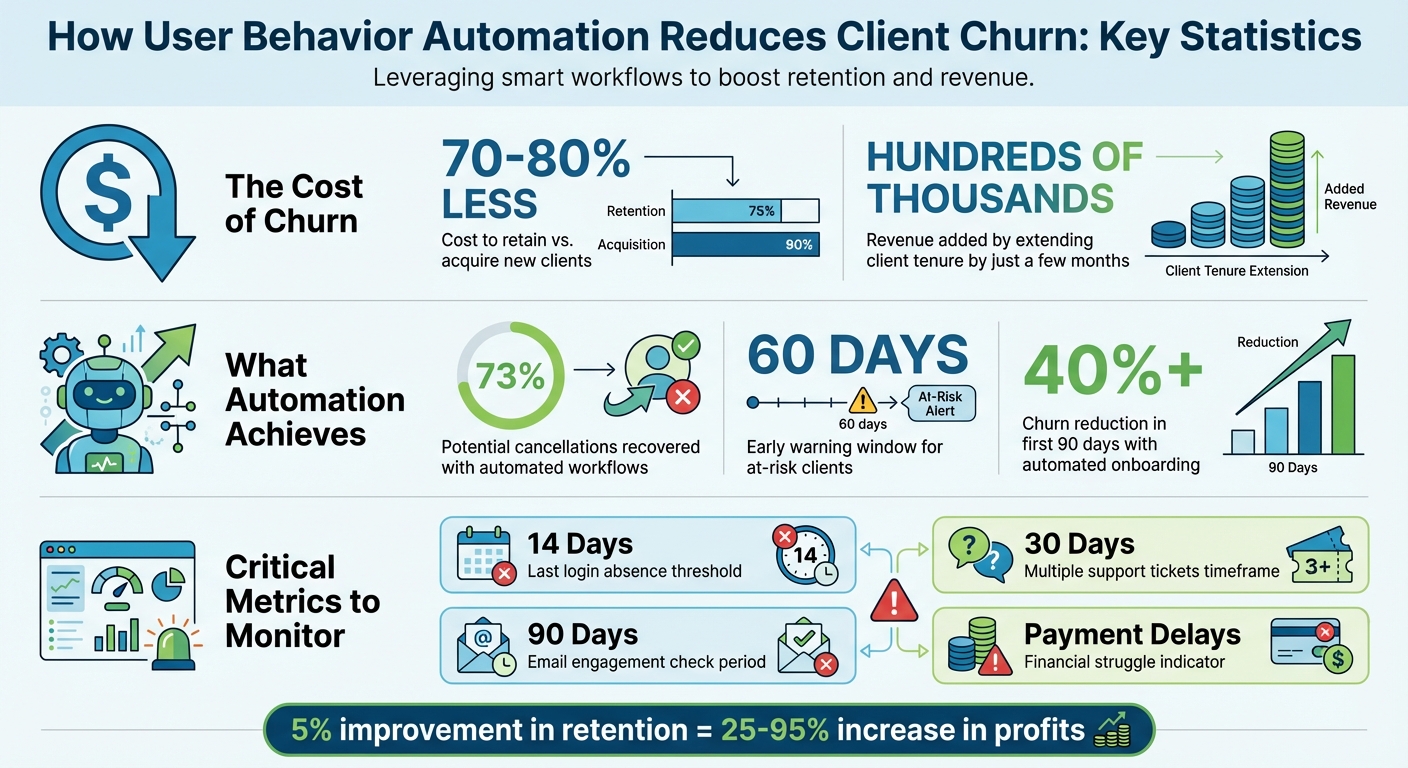
- Retaining clients costs 70-80% less than acquiring new ones.
- Extending client tenure by just a few months can add hundreds of thousands in revenue.
- Automated tools like GoHighLevel track behaviors (e.g., logins, payments, support tickets) and flag risks up to 60 days in advance.
By using behavior tracking and automated workflows, businesses can recover 73% of potential cancellations and deliver consistent, timely engagement. Automation not only saves time but ensures no client slips through the cracks, making churn prevention scalable and reliable.
Key Takeaways:
- Focus on the first 90 days: Automate onboarding and check-ins to strengthen relationships.
- Track metrics like login frequency, payment delays, and support ticket spikes to spot early warning signs.
- Use health scoring systems to prioritize clients needing attention.
- Automate retention campaigns to re-engage at-risk clients effectively.
Start by implementing a tool like GoHighLevel to streamline these processes, reduce churn, and grow your business without adding more workload.
Client Churn Reduction Statistics and Key Metrics
What Causes Client Churn and Why It's Hard to Stop
Top Reasons Clients Leave
Most clients don’t voice their dissatisfaction - they simply disengage. One of the biggest culprits? Poor onboarding. If clients don’t see quick wins within the first 14 days, they start questioning their decision. Those early doubts often snowball, creating a shaky foundation for the relationship. Another major factor is the lack of clear, perceived value. If clients can’t easily recognize the return on their investment, they’ll assume it doesn’t exist.
Other triggers include inconsistent communication, unresolved support issues, and billing headaches. Behavioral patterns can also signal trouble: long gaps since the last login, a spike in support tickets, late or irregular payments, missed meetings, and slow responses to your outreach. These warning signs highlight why relying on automated tracking is critical.
Why Manual Churn Prevention Doesn't Work
Manual tracking has a major flaw - it’s too slow and inconsistent. By the time someone notices that a client hasn’t logged in for two weeks, the client may have already checked out mentally. Manual methods are reactive, always playing catch-up instead of addressing potential issues before they escalate.
As your business grows, the workload increases, and retention efforts often take a backseat to closing new deals or completing projects. This leads to inconsistent practices - one account manager might catch a warning sign, while another completely misses it. These gaps make it clear why automation is necessary. Automated solutions create consistency and ensure no red flags slip through the cracks, giving you a proactive way to tackle churn.
sbb-itb-f031672
How Behavior Tracking Identifies At-Risk Clients
Which Metrics Actually Matter
When it comes to predicting client churn, some metrics stand out more than others. Key indicators include last login date, support ticket volume, payment patterns, and engagement drop-offs. For instance, if a client hasn’t logged in for 14 days, it’s a clear warning sign. Similarly, an uptick in support tickets - especially multiple submissions within 30 days - can point to growing frustration. Late payments often hint at financial struggles, a common precursor to cancellations.
Other red flags include a noticeable decline in meeting attendance, slower response times, or a lack of email engagement - such as no opens in 90 days. Advanced AI tools can even analyze communication for concerning phrases like "considering other options", "not seeing results", or "budget concerns".
The most effective way to manage these signals is through a health scoring system. Here’s how it works: assign point values to specific behaviors. For example, subtract 10 points for a 14-day login absence, 20 points for a late payment, and 15 points for multiple support tickets. On the flip side, positive actions like referrals can add points. If a client’s score drops below a set threshold - say, 50 points - it’s time to act. This scoring system allows for proactive churn prevention, giving you actionable insights to retain clients before it’s too late.
How Automation Turns Data Into Action
Tracking these critical metrics is only half the battle. Without swift action, even the most detailed tracking won’t prevent churn. That’s where automation steps in, transforming raw data into immediate, targeted responses. Tools like GoHighLevel excel at monitoring these signals in real time, assigning health scores, and automatically moving clients through pipeline stages - from "Healthy" (Green) to "At Risk" (Yellow) to "Critical" (Red).
When a client’s score dips below the threshold, automation springs into action. Systems like GoHighLevel can instantly send SMS alerts, create follow-up tasks in your CRM, and even assign team members to address the issue. According to GoHighLevel, their AI-driven automation can recover 73% of potential cancellations by flagging at-risk clients early and enabling proactive engagement. This early warning system provides a valuable window to resolve issues before clients decide to leave.
Additionally, during the crucial first 90 days of a client relationship, automated ROI reports play a key role in reinforcing your value. By consistently showcasing results, these reports keep your services top of mind, reducing the likelihood of second-guessing their investment. This approach lays the groundwork for successful onboarding and retention strategies, which we’ll delve into next.
3 Systems That Radically Reduce Client Churn (Yet Most Agencies Ignore)
Setting Up Automation Workflows That Reduce Churn
Once you've pinpointed the behaviors that signal a risk of churn, the next step is to create automated workflows designed to step in before clients leave.
Automated Onboarding to Strengthen Early Engagement
The first 90 days are crucial for keeping clients around. Start the onboarding process immediately after closing a deal. With GoHighLevel, this can happen within minutes: a welcome email and SMS are sent automatically, including links to a kickoff call and intake forms. At the same time, internal tasks like setting up sub-accounts, tracking pixels, and domain connections are triggered. If a client hasn't completed their intake form, an automated reminder ensures nothing slips through the cracks.
During this critical period, reinforce your value with scheduled check-ins. For example:
- A quick-win check-in on Day 14
- An ROI summary on Day 30
- A strategy session on Day 60
These simple but effective strategies can cut churn by over 40% in the first 90 days and potentially extend the average client relationship from 8 months to more than 2 years. Early automation like this helps address the risks you identified earlier.
Churn Alerts and Automated Win-Back Campaigns
Using the client health scoring system mentioned earlier, integrate it with GoHighLevel to automatically sort clients into a retention pipeline. This pipeline can classify clients into categories like "At Risk", "Critical", or "Recovery" when their health score dips below a set threshold.
GoHighLevel's AI features can also scan client communications for warning signs, such as phrases like "budget concerns", "not seeing results", or "considering other options." When these red flags appear, an instant SMS check-in is triggered, and an urgent task is assigned to the account manager. For clients who haven’t interacted in 90 days or are nearing their contract renewal, launch a multi-channel win-back campaign. This could include personalized emails, SMS messages, and a follow-up call within 24 hours.
Automated Feedback and Support Systems
GoHighLevel's Reputation Management tool can simplify feedback collection by automatically requesting reviews after key project milestones. If a low rating comes in, the account manager is immediately alerted to address the issue. Additionally, set up automated surveys for inactive clients with questions like, "What’s one thing we could improve?"
The AI Employee feature in GoHighLevel can monitor communications for concerning phrases, ensuring quick follow-ups and task assignments. A "Missed Call Text Back" workflow can also be implemented, sending an SMS to confirm a return call within the hour. These feedback systems not only save money - costing 70–80% less than acquiring new clients - but even a modest 5% improvement in retention can lead to a 25% to 95% increase in profits.
For more advanced automation strategies, check out HL Max (https://hlmax.co). Their guides offer actionable advice on using GoHighLevel to streamline your marketing efforts and achieve measurable results over time.
Why GoHighLevel Works Best for Behavior Automation
When agencies weigh options like ChurnZero, Zendesk, and other CRM-automation tools, they often find themselves juggling multiple platforms. GoHighLevel, however, sets itself apart by offering an all-in-one solution. For agencies and small businesses, this means no more patching together a fragmented tech stack.
GoHighLevel vs. Other Platforms
ChurnZero shines in behavior tracking for SaaS companies, while Zendesk is a go-to for managing support tickets. But neither platform is tailored for agencies handling multiple clients, nor do they offer white-label capabilities. GoHighLevel, on the other hand, not only provides advanced behavior tracking and automation but also allows you to rebrand the platform entirely. This means your clients interact with your branded app for tasks like reviews, bookings, and communication - making them less likely to leave.
| Platform | Behavior Tracking | Automation Triggers | Agency White-Label | Cost Efficiency |
|---|---|---|---|---|
| GoHighLevel | Yes | Yes | Yes | High |
| ChurnZero | Yes | Yes | No | Medium |
| Zendesk | Limited | Limited | No | Medium |
One of GoHighLevel’s standout advantages is its cost-effectiveness. With subscription plans ranging from $97 to $297 per month, it can replace an entire stack of tools. Agencies that switch from using seven separate apps often report a 40% boost in revenue without increasing staff. By unifying behavior tracking and automating engagement, GoHighLevel eliminates the inefficiencies of managing multiple systems, helping agencies focus on reducing churn and driving growth [14,15].
The Learning Curve Is Worth the ROI
Adopting GoHighLevel isn’t just about consolidation - it’s about creating value through implementation. Setting up pipelines, health scoring, and automated workflows typically takes two to three weeks, but the results speak for themselves. For example, one agency owner reclaimed 15 hours per week - essentially the workload of an additional employee - by automating administrative tasks.
The platform’s AI Employee is another game-changer. It scans client messages for phrases like "budget concerns" or "not seeing results" and alerts your team to launch recovery workflows immediately. Unlike Zendesk’s basic ticketing or ChurnZero’s focus on tracking, GoHighLevel lets you act on insights through multi-channel campaigns - SMS, email, and voicemail - all from one dashboard.
For agencies serious about reducing churn and scaling without increasing headcount, the upfront effort to learn GoHighLevel pays dividends. If you’re ready to dive in, HL Max offers detailed guides to help you implement workflows tailored to your needs.
Start Reducing Client Churn Today
What You Need to Remember
Catching the early signs of client dissatisfaction is crucial. Automated tools can help turn warning signals into actionable steps. For example, tracking client behavior can highlight issues like missed logins, delayed payments, or an increase in support tickets - giving you a chance to address problems before they escalate.
Platforms like GoHighLevel simplify this process with features like health scoring, AI sentiment analysis, automated onboarding, and ROI reporting - all integrated into one system. While you could piece together separate tools for these tasks, juggling multiple platforms often creates gaps where clients can get overlooked.
The numbers speak for themselves. Proactive retention efforts can cut churn by up to 40% in just 90 days. Recovering 73% of potential cancellations translates to keeping revenue that might otherwise disappear. Plus, holding onto existing clients is far less expensive than finding new ones. Streamlined workflows not only save time but also deliver a strong return on investment.
How to Get Started
Taking action on these strategies is easier than you might think. Start by testing GoHighLevel with a 14-day free trial to explore its retention tools. Set up a four-stage pipeline - Healthy, At Risk, Critical, and Recovery - based on client health scores. Then, launch a 90-day campaign with ROI reports sent at key intervals (Days 14, 30, and 60) to reinforce your value during periods when client risk is highest. While the setup process may take two to three weeks, the benefits can start showing almost immediately.
For more detailed guidance, HL Max provides step-by-step instructions tailored for agencies and small businesses. This ensures you can effectively use automation to keep your clients engaged and reduce churn for the long haul.
FAQs
How can automating user behavior tracking help reduce client churn?
Automating user behavior tracking is a game-changer when it comes to reducing client churn. By spotting early warning signs - like a drop in activity or missed milestones - businesses can step in before it's too late. This data lets you take action, whether it's sending a personalized offer, a timely reminder, or useful resources to re-engage clients who might otherwise slip away.
When these tailored interactions hit at just the right time, they don't just keep customers happy - they also drive retention and increase overall lifetime value. Tools like HL Max make this process effortless by combining automation with a unified platform. This way, businesses can shift their focus from tedious manual tasks to scaling and growing.
What metrics should you track to spot clients at risk of leaving?
To spot clients who might be thinking about leaving, keep an eye on key behavioral and engagement metrics. These include things like customer satisfaction scores, how engaged they are, and patterns in their feedback.
Also, watch for churn-related signs, such as reduced activity, skipped interactions, or a noticeable drop in how often they use your service.
By tracking these metrics closely, you can tackle potential issues early, offer tailored experiences, and boost retention.
How does GoHighLevel help reduce client churn with behavior automation?
GoHighLevel helps businesses tackle client churn by providing an all-in-one platform tailored for agencies and small businesses. It simplifies client management and marketing with tools that automate tasks like tracking user behavior, sending personalized follow-ups, and building custom workflows. These features ensure businesses can engage clients with timely, relevant interactions that boost satisfaction and loyalty.
What sets GoHighLevel apart is its ability to consolidate multiple tools into a single platform. This eliminates the need for juggling various systems, cutting down on complexity and streamlining operations. With everything in one place, businesses can quickly identify clients who may be at risk, implement targeted retention strategies, and see improved long-term ROI. Plus, its agency-specific features - like white-label options and scalable automation - are perfect for delivering personalized experiences on a larger scale.